
Why I’d start here
If you’re curious about runes but don’t know where to begin, I’d start with the Vimose comb. It’s a small object with just five letters carved above its teeth, so there’s enough to explore without having to work through a long inscription. The comb was found in Denmark in 1865 and dates to around 160 CE. Runologist Marie Stoklund reads the letters as harja. [1]
What I like about this as a first example is that you can follow along even if you don’t know an ancient language. You can look at the photograph, find a couple of matching shapes, and slowly work out where each letter sits. There’s no need to memorize the whole alphabet before you start.
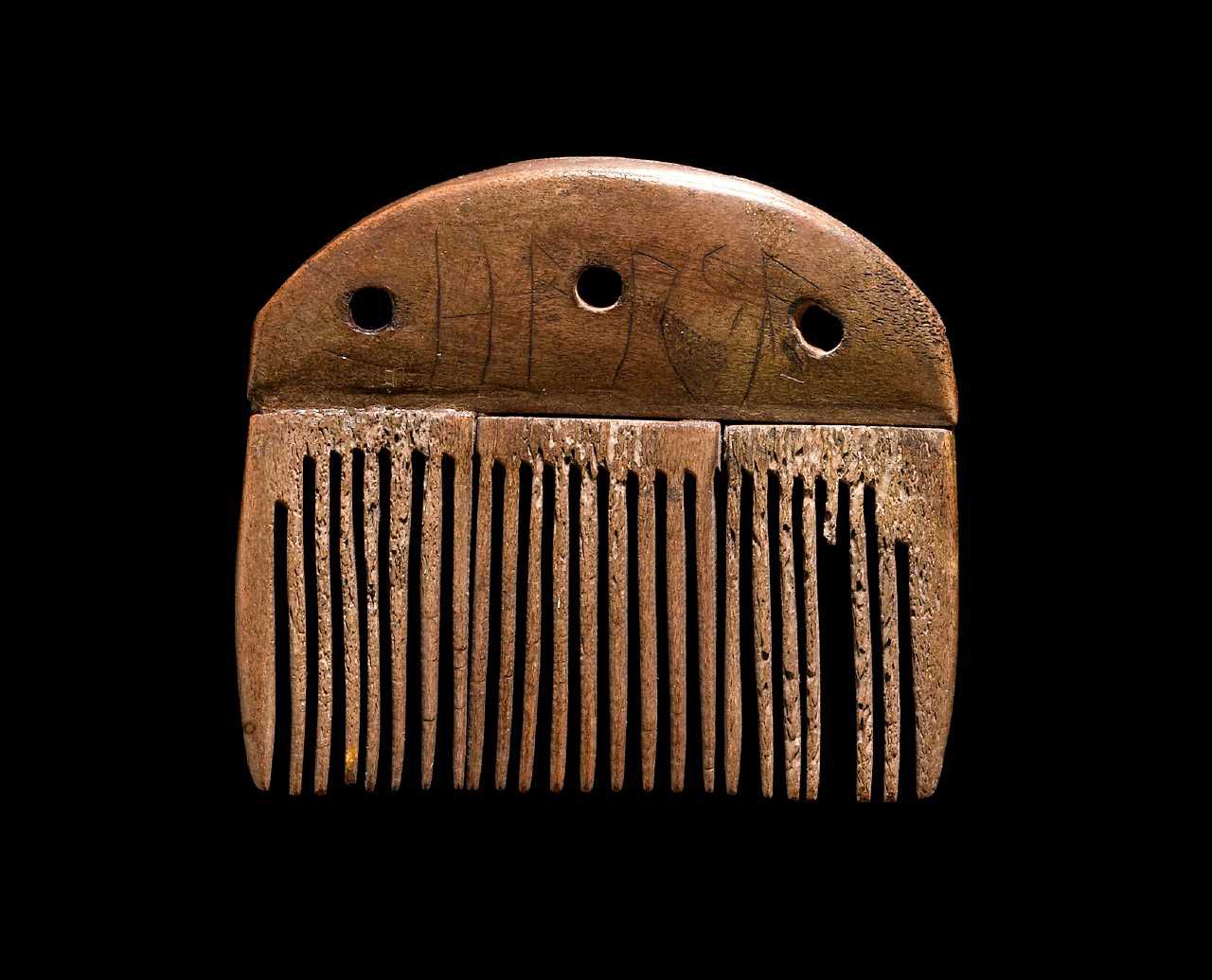
Let’s look at the five letters
I’d look for the two a-runes first. They’re the second and fifth letters, and finding the same shape twice gives you something to build on. Then try the h at the beginning and the r in the middle. That leaves the j in fourth place.
The typed example below makes the sequence easier to see, but keep the photograph nearby. A modern font tidies up the shapes in a way the original carving doesn’t. Once you feel comfortable, cover harja and see how much you can read without it. If you mix up a pair, just take another look at those two.
So what does harja mean?
This is where the answer gets a little less certain. A personal name is the usual explanation. Stoklund also discusses the idea that the word might name the object itself, though she finds that reading less convincing. The letters are clearer than their meaning. [1]
I think that’s part of what makes this little comb interesting. We can read what someone carved nearly two thousand years ago and still have questions about what they meant. You don’t have to settle those questions to enjoy recognizing the letters.
If you’d like a little practice, try the quiz and watch for h, a, r and j. Or come with me to the Kylver stone, where someone carved an entire alphabet.
Sources and reading notes
- Marie Stoklund, Museum OdenseDetailed discussion of the reading harja and competing interpretations.


