
The horns we can still look at
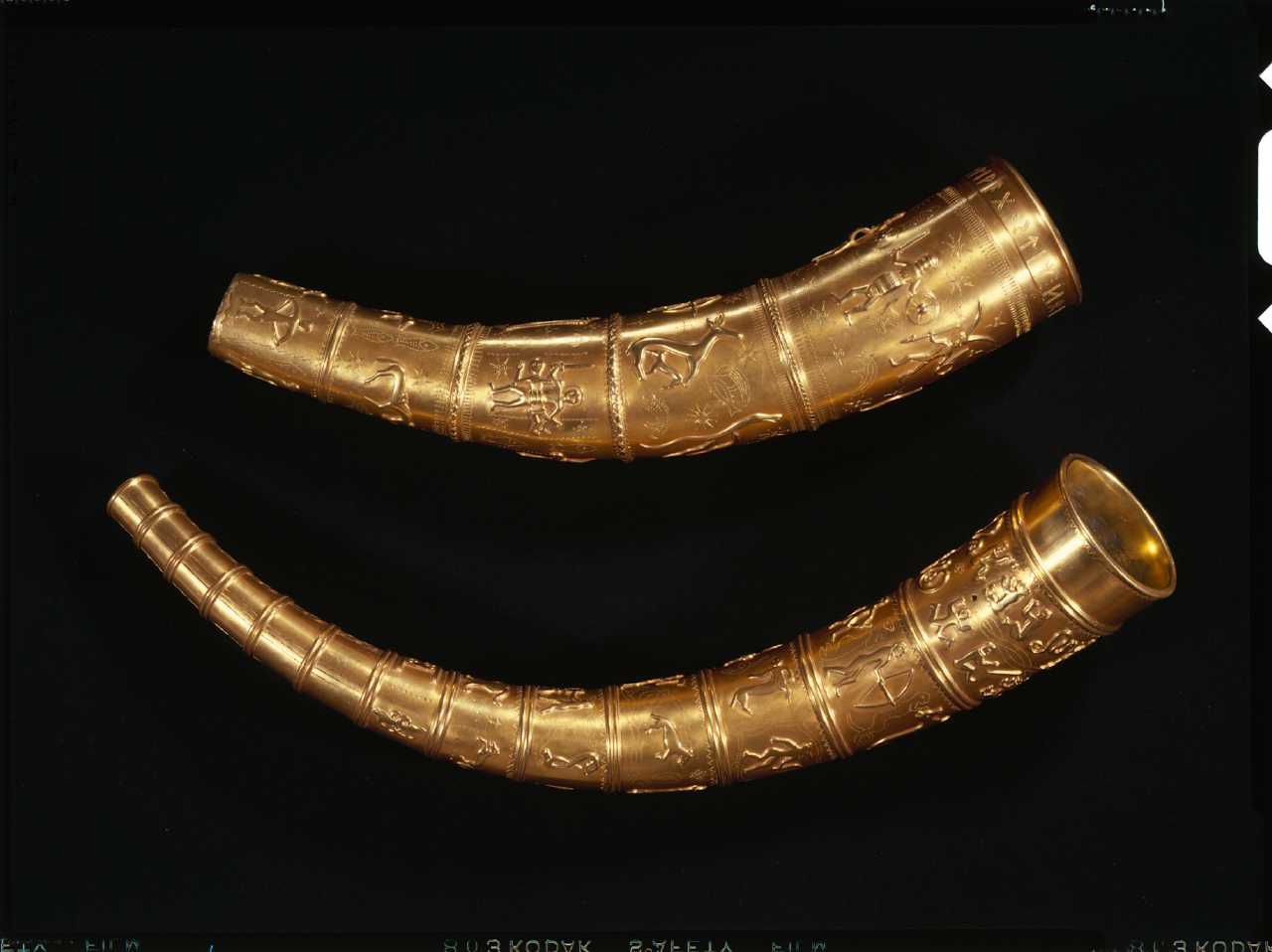
There’s something I’d point out before we look closely at this photograph: these horns are reconstructions. The golden originals came from Gallehus in Denmark and date to around 400 CE. They were stolen and melted down in 1802. The National Museum of Denmark explains how later versions were made using the records that survived. [1]
It’s a sad way to begin a story about beautiful objects, but those earlier records give us a way to keep learning about them. The photograph shows an attempt to recreate what was lost, rather than the ancient surface itself.
Someone left his name
The shorter horn had a runic inscription naming Hlewagastiz and saying that he made it. The museum includes that statement in its account of the horns. [1] What draws me to it is how personal the message feels: someone made an object and put his name on it.
I’d look at the writing alongside the decoration rather than cutting it out into a strip of text. Where does it sit? How does your eye move between the letters and the rest of the horn? The museum’s images give you something to explore, even though we can’t handle or inspect the originals.
Reading through someone else’s record
With an object like this, I want to know what I’m looking at each time: an early drawing, a written account, or a later reconstruction. They can all help, but they preserve different things. A clear drawing may make a letter easier to read because the person who drew it has already decided which marks belong to it.
We can still compare the recorded inscription with a rune chart. We just can’t use a modern reconstruction to judge the exact depth of the original cuts or the condition of a particular letter.
If you’d like to compare that with something that does survive, take a look at the Kylver stone. I find the two worth reading together: one lets us return to the stone, while the other reminds us how much can depend on someone taking the time to make a record.
Sources and reading notes
- National Museum of Denmark: The Golden HornsHistory of the objects, their loss and later reconstructions.


